
Picture this: someone tosses a box of old patient files into a regular dumpster, and a passerby finds it. That one slip can trigger a federal investigation. HIPAA requires covered entities to make protected health information unreadable and unrecoverable when they dispose of it, whether it’s paper charts, prescription labels, or old hard drives. If you don’t, the Office for Civil Rights can fine you from $145 to over $2.19 million per violation, depending on how culpable you are. Individuals who knowingly mishandle PHI can also face criminal charges, including prison time. So what do these penalties look like for improper waste disposal? Let’s break it down.
HIPAA Waste Disposal: Summary
Improper disposal of protected health information can expose healthcare organizations to civil or criminal penalties, investigations, and corrective measures. HIPAA requires PHI to be rendered unreadable before disposal, while electronic media and disposal vendors require appropriate safeguards and agreements. Penalties vary by violation circumstances and may accumulate for continuing violations. Healthcare providers should also understand reporting duties, enforcement timelines, employee training requirements, recognized security practices, and disposal obligations regardless of practice size.
What Makes Improper Waste Disposal a HIPAA Violation?
Protecting Patient Information Includes Throwing It Away
HIPAA’s Privacy Rule says healthcare providers must protect patient information in every form, on paper or on screen. Under 45 CFR 164.530(c), this duty covers disposal too. A record does not lose its protection just because the clinic no longer needs it.
Not Making PHI Unreadable Before Disposal
HHS says patient papers must be made unreadable and impossible to piece back together [1] before disposal. Shredding, burning, pulping, or pulverizing all work. HIPAA doesn’t require one method, just a result that can’t be rebuilt.
Ignoring Disposal Rules for Electronic Devices
According to the U.S. Department of Health & Human Services (HHS), the HIPAA Security Rule requires covered entities to have policies and procedures addressing [2] the final disposition of ePHI and the hardware or electronic media on which it is stored, like hard drives, USB drives, and old computers. Copiers are easy to forget: in 2013, Affinity Health Plan paid $1.2 million for returning leased copiers with patient data still inside.
Using Vendors Without the Right Agreements
HHS explains that a covered entity may hire a business associate to dispose of PHI [3], but the parties must have a contract or other agreement requiring the business associate to appropriately safeguard the PHI. Without one, handing over records can be a violation, even if the shredding is done properly.
To understand how document shredding works and why it matters, explore our in-depth blog.
Keep patient records safe from start to finish. Choose Secure Waste for reliable, compliant, and affordable disposal you can count on!
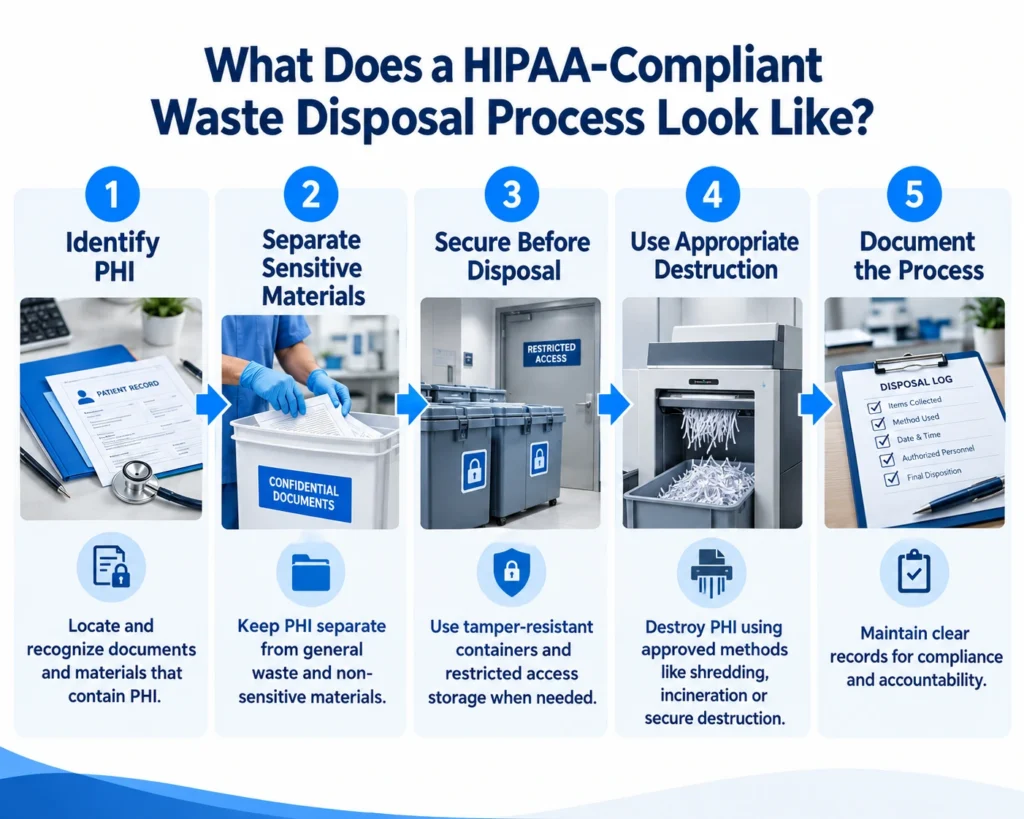
What Does a HIPAA-Compliant Waste Disposal Process Look Like?
Safe disposal of patient records is more than using a shredder. It takes five simple steps: find the records with patient information, keep them apart from regular trash, lock them up until disposal, destroy them the right way, and write down what was done. Every step keeps patient details safe until they are gone.
HIPAA Penalties for Improper Disposal of Protected Health Information
Four Penalty Tiers Based on How Careless the Organization Was
HHS groups HIPAA fines into four levels based on how much the organization is to blame. The levels are: didn’t know, had a reasonable cause, ignored the rules but fixed it within 30 days, and ignored the rules and never fixed it. The more careless the organization, the bigger the fine.
How Repeated Violations Add Up
When a violation keeps happening, HIPAA counts each day as a separate violation. The U.S. Department of Health & Human Services (HHS) explains these enforcement requirements under the HIPAA Enforcement Rule [4]. If a dumpster keeps receiving unshredded patient records, or a weak disposal process stays in place, the daily fines can pile up fast and turn a small mistake into a costly problem.
Criminal Penalties for Knowing Misuse of Patient Data
The U.S. Department of Health & Human Services (HHS) states that knowingly obtaining or disclosing individually identifiable health information in violation of HIPAA [5] can result in criminal penalties. Penalties can reach $50,000 and one year in prison. If the act is done for profit or to cause harm, penalties rise to $250,000 and 10 years.
State Attorneys General Can Also Take Action
HHS explains that state attorneys general have authority under the HITECH Act to bring civil actions on behalf of state residents for violations of the HIPAA Privacy and Security Rules [6]. They may seek damages on behalf of state residents or ask a court to stop further violations.
Fine Amounts Per Violation in 2026
For 2026, the applicable federal civil monetary penalty amounts are adjusted annually under the federal inflation-adjustment requirements. The specific amount that may apply depends on the penalty tier, the circumstances of the violation, and the applicable annual cap.
Conclusion
Keeping patient information safe shouldn’t cause you stress. For over 25 years, Secure Waste has helped healthcare practices in Maryland, Virginia, and Washington, D.C. manage waste with confidence. With NAID-compliant shredding, certified data destruction, no contracts, flexible schedules, and no hidden fees, it’s a simple, trusted choice for practices that want to stay protected and focus on patients.
Protect your patients’ privacy and your practice today. Partner with Secure Waste for safe, simple, affordable disposal you can trust!
FAQ’s About HIPAA Disposal Penalties
1. How long can regulators act after records are thrown away?
Regulators usually have six years from the date of the violation to take action. So even if patient records were tossed in a dumpster years ago, an investigation can still happen if the problem is discovered later.
2. Can strong security practices reduce HIPAA penalties?
Yes, they can. A 2021 federal law says regulators must check whether an organization followed recognized security practices during the past 12 months. If it did, the fines may be lower, and audits or investigations may be shorter.
3. Do staff need training on how to dispose of patient records?
Yes. HIPAA requires healthcare providers to train all employees on their privacy policies, including how to handle and dispose of patient information. Well-trained staff is one of the best ways to prevent accidental disposal mistakes.
4. Do providers have to report it if records are found in a public dumpster?
Usually, yes. Affected patients must be told as soon as possible, and no later than 60 days after the problem is found. If 500 or more people are affected, HHS must be told too. Smaller cases can be reported to HHS after the year ends.
5. Do small clinics and solo practitioners have to follow disposal rules?
Yes. HIPAA applies to all healthcare providers, no matter how small. A one-doctor office must protect and properly destroy patient records in the same way a large hospital does.
Citation
[1] U.S. Department of Health & Human Services (HHS), “What Do the HIPAA Privacy and Security Rules Require of Covered Entities When They Dispose of Protected Health Information?”
[2] U.S. Department of Health & Human Services (HHS), “Summary of the HIPAA Security Rule.”
[3] U.S. Department of Health & Human Services (HHS), “May a Covered Entity Hire a Business Associate to Dispose of Protected Health Information?”
[4] U.S. Department of Health & Human Services (HHS), “The HIPAA Enforcement Rule.”
[5] U.S. Department of Health & Human Services (HHS), “Protecting the Privacy of Patients’ Health Information.”
[6] U.S. Department of Health & Human Services (HHS), “State Attorneys General.”
Expert Medical Waste Management: With over 25 years of industry experience, Secure Waste is a trusted local leader in hazardous and biohazardous waste disposal across Maryland, Virginia, and Washington, D.C. Specializing in medical waste management, sharps needle disposal, and biohazard waste removal, the company ensures full compliance with federal, state, and local regulations while prioritizing environmental sustainability.
The company also offers additional services, including secure document shredding and sharps container sales, providing comprehensive solutions for healthcare facilities and businesses. Our cost-effective services help clients maintain regulatory compliance without unexpected costs.
With a commitment to customer satisfaction, Secure Waste offers tailored waste management plans that align with industry best practices. Their team of experts provides reliable, timely, and compliant services, making them the preferred choice for medical waste disposal. For a free waste quote or more information, visit www.securewaste.net