Transporting medical waste across state lines requires following federal rules that protect drivers, waste handlers, emergency responders, and the public from exposure to infectious materials. The U.S. Department of Transportation (DOT) regulates the transportation of hazardous materials, including certain infectious substances and regulated medical waste. These rules cover waste classification, packaging, marking, labeling, shipping papers, and employee training, depending on the shipment. Understanding which DOT regulations apply helps healthcare facilities, medical waste companies, and carriers meet their responsibilities and avoid compliance violations.
Summary of DOT Medical Waste Regulations
Transporting medical waste across state lines requires compliance with applicable DOT hazardous materials regulations, including waste classification, approved packaging, labeling, shipping documentation, and employee training. State-specific permits, tracking requirements, and disposal rules may also apply. Facilities should verify transporter registrations, review enforcement histories, confirm subcontractor oversight, and compare transparent service quotes. Understanding emergency response procedures and recordkeeping obligations helps reduce compliance risks, protect public health, and support safe, legally compliant medical waste transportation.
Which DOT Regulations Govern Interstate Medical Waste Transportation?
49 CFR § 173.134 – Medical Waste Classification
This regulation classifies infectious substances and regulated medical waste for transportation. Most routine regulated medical waste containing Category B infectious substances is assigned UN3291 under Hazard Division 6.2. Waste containing higher-risk Category A infectious substances requires a different classification and stricter handling. Proper waste identification is essential before transportation. The regulation also specifies exceptions for qualifying waste and shipments.
49 CFR § 173.197 – Medical Waste Packaging Requirements
This regulation establishes packaging requirements to prevent leakage, spills, punctures, and accidental exposure. It covers rigid containers, sharps containers, large packagings, and authorized bulk containers. Contaminated needles and scalpels must be placed in securely closed, puncture-resistant sharps containers. Non-bulk packages generally must meet UN packaging standards at the Packing Group II performance level. However, certain private or contract carrier shipments qualify for alternative packaging requirements under § 173.134(c)s [1].
49 CFR Part 172 – Medical Waste Marking and Labeling
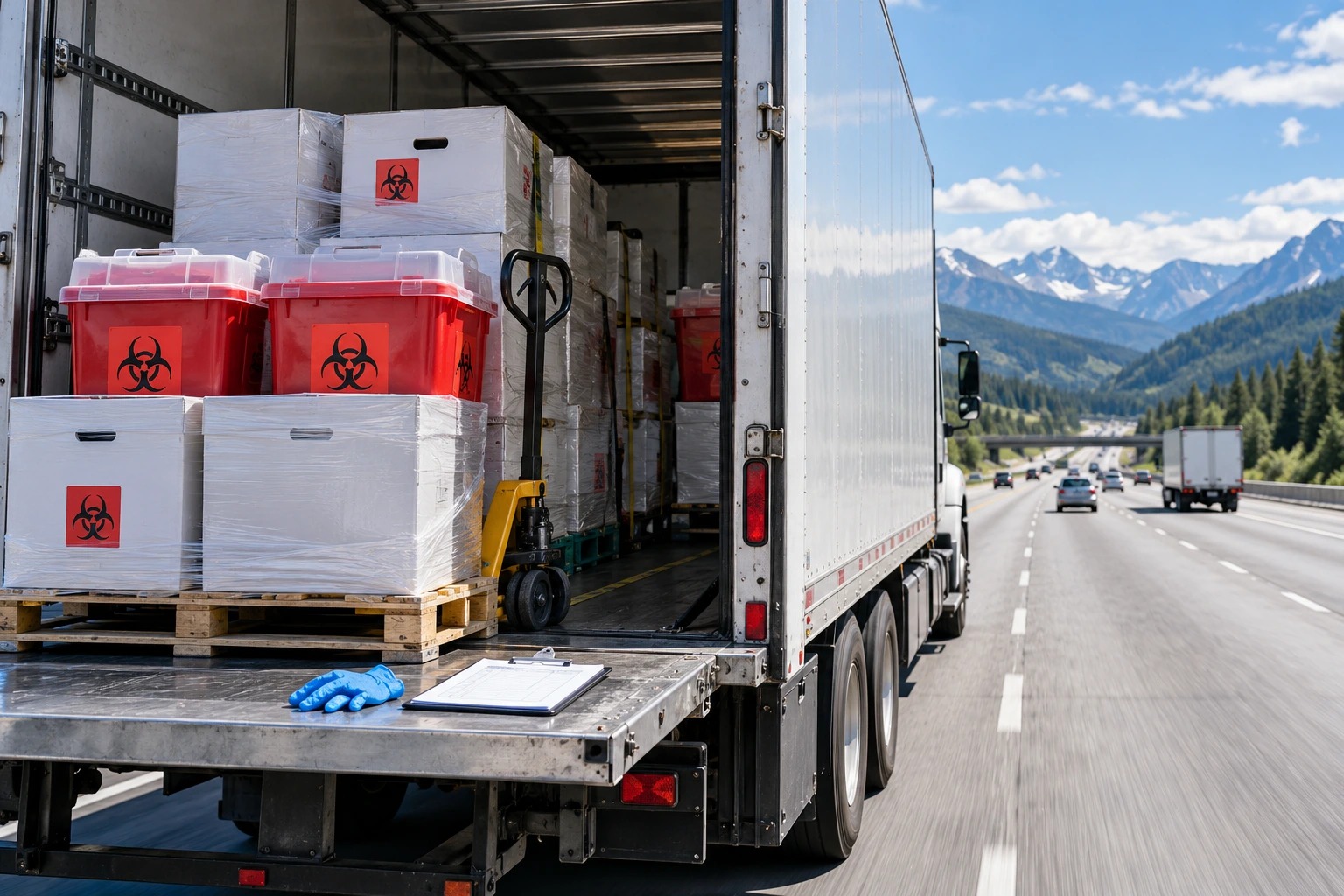
Part 172 establishes requirements for identifying hazardous materials during transportation. Regulated medical waste packages generally require the proper shipping name, UN identification number, and INFECTIOUS SUBSTANCE hazard label. An exception allows compliant BIOHAZARD markings to replace the infectious substance label for regulated medical waste transported by private or contract carriers. Division 6.2 regulated medical waste transported alone does not require DOT vehicle placards, although applicable package marking and labeling requirements remain in effect. For the complete federal requirements, see 49 CFR Part 172 [2], Hazardous Materials Table, Special Provisions, Hazardous Materials Communications, Emergency Response Information, and Training Requirements..
49 CFR §§ 172.200–172.205 – Shipping Papers and Documentation
These sections establish shipping paper requirements for hazardous materials shipments. Documentation identifies the transported material and provides information needed during emergencies. Required information generally includes the proper shipping name, UN identification number, hazard division, number and type of packages, total quantity, and shipper certification where applicable. A typical shipment may use the description “UN3291, Regulated medical waste, n.o.s., 6.2.” Under § 177.817, drivers must keep required shipping papers readily accessible during transportation. For detailed shipping paper requirements, review 49 CFR Part 172, Subpart C, Shipping Papers [3].
49 CFR § 172.704 – Hazardous Materials Employee Training
Employees performing DOT-regulated hazardous materials transportation functions must receive appropriate training. Training covers hazardous materials identification, job-specific responsibilities, safe handling, emergency response information, and security awareness. Employees preparing shipments must understand applicable packaging, marking, and documentation requirements, while drivers need training relevant to their duties. DOT-required hazardous materials training must generally be repeated at least once every three years.
49 CFR Part 177 – Safe Transportation by Highway
Part 177 establishes highway transportation safety requirements for hazardous materials. Under § 177.834, packages must be secured to prevent shifting during normal driving conditions, including sudden braking and turning. The regulations also address loading, unloading, package handling, and shipping paper accessibility. These requirements help reduce container damage, accidental exposure, and waste releases during transit.
Do State Medical Waste Transportation Rules Also Apply?
Yes. States may impose additional requirements alongside federal DOT transportation rules. Depending on the jurisdictions involved, transporters may need permits, medical waste tracking documentation, or authorization to deliver waste to approved treatment facilities. Interstate businesses must therefore assess applicable federal requirements and the state-specific rules governing each jurisdiction.
Let your medical waste leave without leaving you worried. Secure Waste Inc. offers flexible pickups, clear pricing, and no contracts!
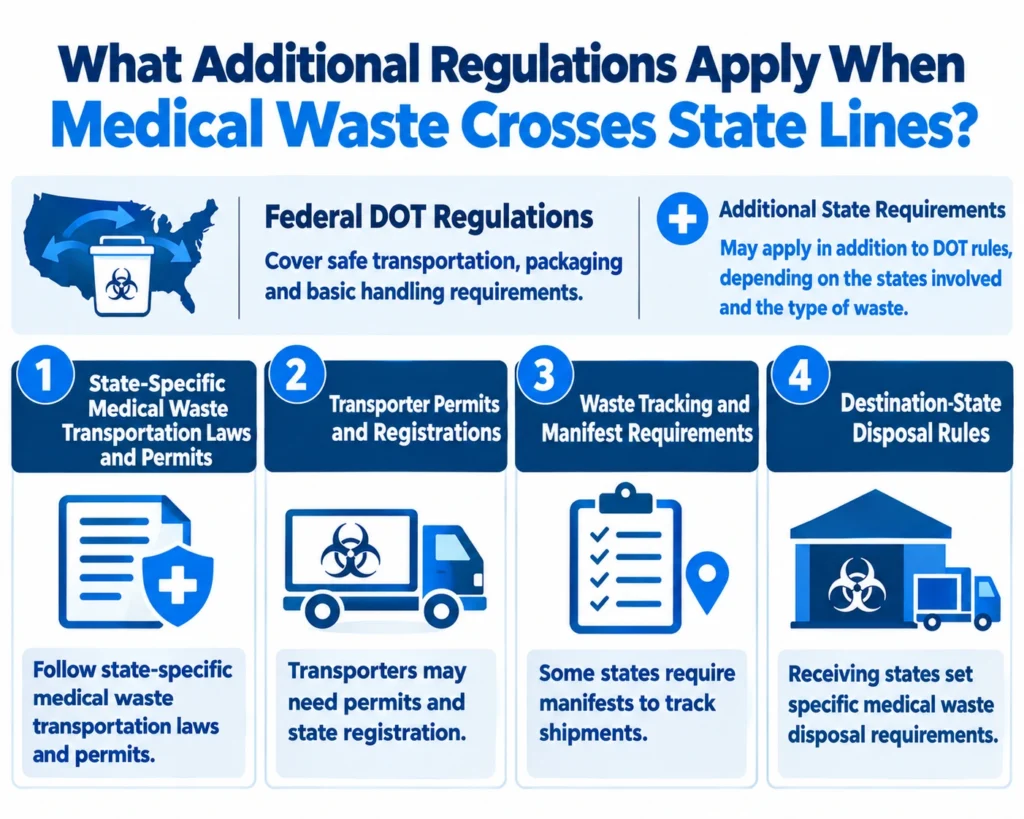
What Additional Regulations Apply When Medical Waste Crosses State Lines?
DOT rules are only the first step when medical waste crosses state lines. Each state may add its own rules. This infographic covers four checks: state medical waste laws, hauler permits, tracking papers where needed, and disposal rules in the state where the waste ends up. Not every rule applies to every shipment.
How Do You Choose a DOT-Compliant Medical Waste Transportation Provider?
PHMSA Hazmat Registration: 49 CFR Part 107, Subpart G
Certain businesses that offer or transport hazardous materials must register annually with PHMSA under 49 CFR Part 107, Subpart G. The requirements depend on the materials, quantities, packaging, and applicable regulatory criteria. Review PHMSA’s registration requirements [4] to determine whether registration applies and how to check a provider’s registration status.
PHMSA Enforcement History
PHMSA publishes hazardous materials enforcement decisions online. You can use its Hazmat Enforcement Actions Search [5] to look for published cases involving a transportation provider. Search the company’s name to see past fines or warning letters for hazmat violations. Repeated violations suggest a weak safety program that could put your shipments at risk.
Partner Carriers and Hand-Offs
Ask whether the company uses its own drivers for the whole trip or passes loads to partner carriers. Every carrier on the route must follow the rules, so ask for the partners’ names and how they are checked.
Clear Quotes and Low-Price Warning Signs
Ask for a quote that lists each fee: pickup, containers, fuel, and treatment. A price far below other bids can mean corners are cut on packing or disposal, which could leave your facility at risk if waste is mishandled.
Conclusion
Observation starts with the right partner. Secure Waste Inc. makes it easy to move all the medical waste across Maryland, Virginia, and Washington, D.C. With over 25 years of experience, the team uses containers that meet all DOT rules and EPA-approved treatment. It is licensed, bonded, and insured, with no long-term contracts and clear pricing, so you can stay compliant.
Ship safely, without the worry. Get a waste check from Secure Waste Inc. and plan with no contract for your facility!
FAQ’s About DOT Regulations for Transporting Medical Waste Across States
Do DOT rules apply if the medical waste stays inside one state?
Yes. DOT hazmat rules also cover many shipments that stay in one state. Many states use them on local roads, so even a short trip across town may need the same packing and labels.
Who is responsible if a shipment is packed or labeled wrong?
The shipper is. When you sign the shipping paper, you promise the waste is sorted, packed, and labeled correctly. A carrier can be cited for its own mistakes, but packing errors fall on you.
What should I do if medical waste leaks during transport?
Keep people away and clean up the spill only if it is safe. Serious incidents must be reported to DOT by phone right away, and a written report is due within 30 days.
Can my facility move its own medical waste?
Yes, but you act as both the sender and the driver. You must follow all DOT rules for both jobs, including driver training. Some states may also ask you to register as a hauler.
How long should I keep copies of shipping papers?
Keep a copy for two years after the carrier picks it up. If the waste is also hazardous, keep it for three years. Paper or digital copies are fine. Keep them easy to find.
Citation
[1] Electronic Code of Federal Regulations (eCFR). 49 CFR § 173.197 – Regulated medical waste. U.S. Department of Transportation.
[2] Electronic Code of Federal Regulations (eCFR). 49 CFR Part 172 – Hazardous Materials Regulations. U.S. Department of Transportation.
[3] Electronic Code of Federal Regulations (eCFR). 49 CFR Part 172, Subpart C – Shipping Papers. U.S. Department of Transportation.
[4] Pipeline and Hazardous Materials Safety Administration (PHMSA). Registration Information. U.S. Department of Transportation.
[5] Pipeline and Hazardous Materials Safety Administration (PHMSA). Transporting Infectious Substances Safely. U.S. Department of Transportation
Expert Medical Waste Management: With over 25 years of industry experience, Secure Waste is a trusted local leader in hazardous and biohazardous waste disposal across Maryland, Virginia, and Washington, D.C. Specializing in medical waste management, sharps needle disposal, and biohazard waste removal, the company ensures full compliance with federal, state, and local regulations while prioritizing environmental sustainability.
The company also offers additional services, including secure document shredding and sharps container sales, providing comprehensive solutions for healthcare facilities and businesses. Our cost-effective services help clients maintain regulatory compliance without unexpected costs.
With a commitment to customer satisfaction, Secure Waste offers tailored waste management plans that align with industry best practices. Their team of experts provides reliable, timely, and compliant services, making them the preferred choice for medical waste disposal. For a free waste quote or more information, visit www.securewaste.net