
Healthcare workers (HCWs) have been at risk for decades of acquiring bloodborne pathogens due to their daily occupational exposure. According to the National Institutes of Health (NIH), about 3 million HCWs are exposed to bloodborne pathogens each year, posing risks such as Hepatitis B, Hepatitis C, and HIV. They are transmitted through contact with contaminated blood or bodily fluids. Hence, for the safety of HCWs, compliance extends to proper management and disposal of contaminated materials. Employers and healthcare professionals can significantly reduce the risk of bloodborne pathogen transmission by adhering strictly to OSHA’s Bloodborne Pathogens Standard.
To present you with the right guidance on this compliance initiative, this guide explains OSHA bloodborne pathogen training requirements, including how often training is required, what it should include, who needs it, and how employers can maintain compliance.
OSHA Training Requirements Overview
OSHA training requirements help healthcare employers protect workers from bloodborne pathogens and other workplace hazards while maintaining compliance. Bloodborne Pathogens training applies to employees with occupational exposure, not only healthcare workers, and must be provided initially and at least annually. OSHA does not mandate a specific training duration; employers must ensure training covers required topics and matches job-specific risks. Proper documentation, timely retraining, and updated safety procedures support ongoing OSHA compliance.
How Often Does OSHA Require Bloodborne Pathogen Training?
OSHA’s Bloodborne Pathogen (BBP) is a course for workers who are at potential risk of getting infected due to their occupational exposure risk. Workers need to be given training that must include
OSHA requires BBP training at least annually
Under 29 CFR 1910.1030(g)(2)(ii), employees with occupational exposure to blood or OPIM must receive bloodborne pathogens training before or at the time of initial assignment to exposure-related duties and at least annually thereafter, with annual training completed within one year of the previous training. But it does not have to be an exact repetition of initial training. Therefore, an employer generally cannot rely on simply conducting one BBP class every January and assume every employee is automatically compliant.
Additional training is required when workplace conditions change
Annual training isn’t the only trigger. Employers must provide additional training when changes to tasks or procedures, or the introduction of new ones, affect an employee’s occupational exposure. The additional training can be limited to the new exposures created by the change.
That may include
- Introduction of New Equipment: Switching to a new type of retractable syringe or a needleless IV system requires instruction on how the specific new device works.
- Changes in Job Procedures: A laboratory worker shifting from handling routine clinical samples to culturing high-concentration HIV or Hepatitis B viruses.
- New Department Assignments: A custodian or maintenance worker moving into a high-risk research or medical waste handling area where they face novel exposure hazards.
- Process Alterations: Changing the clean-up protocol or introducing new chemical disinfectants for blood spill responses.
OSHA does not prescribe a specific number of training hours
A common misconception is that OSHA requires a specific number of hours, such as five hours every 90 days. OSHA has explicitly stated that this is incorrect. The BBP standard establishes frequency and required content, but does not prescribe a universal training duration.
For example, a healthcare clinic may provide a 1-hour BBP training session if it adequately covers OSHA’s required content and allows employees to understand and apply the necessary safety practices. A more complex healthcare setting may require a longer session to address additional procedures, equipment, or exposure risks. OSHA compliance is therefore based on the content and effectiveness of the training, not simply the number of hours completed.
Important Note
Covered employers must provide BBP training at no cost to employees and during working hours. OSHA has interpreted “working hours” as company time.
What Does OSHA Bloodborne Pathogen Training Need to Include?
1. Basic knowledge of bloodborne pathogens
Employees should understand what bloodborne pathogens are, how they are transmitted, and the health risks associated with exposure. Training must cover the symptoms and epidemiology of bloodborne diseases and their modes of transmission, including diseases such as hepatitis B (HBV), hepatitis C (HCV), and HIV.
2. Recognizing exposure risks
Training should explain which workplace tasks can involve blood or OPIM exposure, such as handling contaminated sharps, providing first aid, cleaning contaminated surfaces, handling specimens, and managing contaminated materials or waste.
3. Exposure prevention and safe work practices
Employees should learn how to prevent or minimize exposure through appropriate work practices, hand hygiene, and safe handling of blood, OPIM, and contaminated materials.
Employers must use engineering controls and work-practice controls to eliminate or minimize occupational exposure. These can include safer medical devices, needleless systems, and appropriate sharps containers.
4. Personal protective equipment (PPE)
Training must cover the proper selection and use of PPE, including gloves, protective clothing, masks, face shields, and eye protection when appropriate.
OSHA requires employers to provide necessary PPE at no cost to employees and to manage contaminated PPE properly
5. Hepatitis B vaccination
Training must provide information about the Hepatitis B vaccine, including its effectiveness, safety, administration, and benefits. Covered employees must generally be offered the vaccination according to OSHA’s requirements, with specific provisions for employees who initially decline it. It significantly reduces the risk of serious and chronic disease following occupational exposure
6. Exposure control plan
Departments with potential for occupational exposure to bloodborne pathogens (BBP’s) are to identify, in writing, tasks and procedures, as well as job classifications where such exposures may occur without regard to the use of personal protective clothing and equipment.
Departments must also set forth the schedule for implementing other provisions of this policy and specify the procedure for evaluating circumstances surrounding exposure incidents. The procedure must be accessible to employees and available for annual review. Updates are to be performed as necessary when departmental changes occur.
A strong exposure plan works alongside proper waste handling practices. Let Secure Waste help you so your facility can focus on reducing exposure risks and protecting its employees.
Who Needs OSHA Bloodborne Pathogen Training in Healthcare?
Not every healthcare employee has the same level of exposure risk, but anyone whose job duties could reasonably involve contact with blood or other potentially infectious materials (OPIM) needs OSHA Bloodborne Pathogen training. From direct patient care and specimen handling to dental services, instrument processing, and contaminated-linen cleanup, training helps staff recognize risks, use appropriate safeguards, and respond safely to potential exposures.
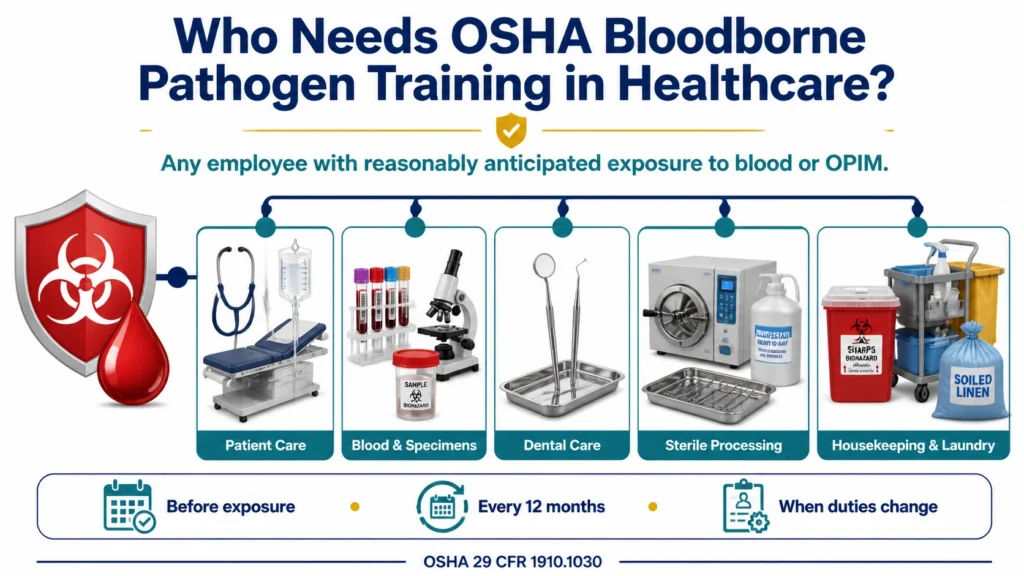
The Important OSHA Rule
It is not the job title alone that determines whether BBP training is required. An employer must determine which employees have occupational exposure based on their actual job duties and tasks.
How Can Healthcare Employers Stay Compliant With OSHA Training Requirements?
Staying compliant with OSHA’s bloodborne pathogen standard requires healthcare employers to take a proactive approach to employee safety and exposure prevention. Employers can use OSHA’s official Compliance Assistance Task as a resource for understanding applicable workplace safety.
Here are the key steps that an employer can deploy to stay compliant:
- Identify training needs: Determine which employees may be exposed to bloodborne pathogens, hazardous chemicals, respiratory hazards, or other workplace risks.
- Provide training on time: Complete required training before or when employees are assigned to tasks involving the relevant hazards. Some standards also require periodic or annual retraining.
- Focus on job-specific risks: Training should reflect the employee’s actual duties, workplace hazards, and protective procedures, not just general safety information.
- Use understandable training: OSHA requires training to be presented in a manner employees can understand and, where applicable, to address worksite-specific procedures and hazards.
- Document training: Maintain records showing who received training, when it was completed, and what training was provided, as required by the applicable OSHA standard.
- Update training when needed: Provide additional training when workplace conditions, tasks, equipment, procedures, or hazards change and existing training is no longer adequate.
- Review compliance regularly: Healthcare employers should periodically review their safety programs and training records to identify gaps and ensure employees remain properly trained.
Conclusion
Healthcare facilities can use the above steps to strengthen bloodborne pathogen safety and maintain OSHA compliance. Proper handling and disposal should remain a key part of these efforts. Working with a reliable provider like Secure Waste can help make medical waste management safer, compliant, and more effective. With over 25 years of experience, our team provides reliable and compliant medical waste disposal services. We help ensure that all waste is disposed of in compliance with OSHA, offering peace of mind for your facility.
Let’s make medical waste management safer. Take the next step toward responsible handling and disposal of regulated medical waste.
OSHA Bloodborne Pathogen Training: Frequently Asked Questions
1. Who can conduct OSHA BBP training?
OSHA does not require a specific professional title for the trainer. The person conducting training must be knowledgeable about bloodborne pathogens and how the requirements apply to the workplace.
2. Can online OSHA BBP training meet OSHA requirements?
Online training may be1. used, but OSHA requires an opportunity for interactive questions and answers and workplace-specific information, such as exposure procedures and the Exposure Control Plan.
3. What are engineering controls for bloodborne pathogens?
Engineering controls are devices or workplace measures that isolate or remove hazards, such as sharps containers, needleless systems, and safety-engineered needles.
4. What is OSHA’s Universal Precautions approach?
Universal Precautions requires employers to treat human blood and certain OPIM as potentially infectious, regardless of the source, to reduce occupational exposure risks.
5. Does OSHA require a sharps injury log?
Covered employers must maintain a sharps injury log for percutaneous injuries from contaminated sharps, subject to OSHA’s applicable recordkeeping requirements and exceptions.
Expert Medical Waste Management: With over 25 years of industry experience, Secure Waste is a trusted local leader in hazardous and biohazardous waste disposal across Maryland, Virginia, and Washington, D.C. Specializing in medical waste management, sharps needle disposal, and biohazard waste removal, the company ensures full compliance with federal, state, and local regulations while prioritizing environmental sustainability.
The company also offers additional services, including secure document shredding and sharps container sales, providing comprehensive solutions for healthcare facilities and businesses. Our cost-effective services help clients maintain regulatory compliance without unexpected costs.
With a commitment to customer satisfaction, Secure Waste offers tailored waste management plans that align with industry best practices. Their team of experts provides reliable, timely, and compliant services, making them the preferred choice for medical waste disposal. For a free waste quote or more information, visit www.securewaste.net