
Essential Types Of Pharmaceutical Waste & Best Practices To Manage Them – Expert Solutions From Secure Waste
Understanding Pharmaceutical Waste in Modern Healthcare
Secure Waste, your local Healthcare waste management company, explains in detail about Pharmaceuticals and Healthcare, so let’s dive deep. Pharmaceuticals are at the heart of modern medicine. Hospitals, surgery centers, long-term care facilities, and clinics rely on thousands of medications every day to treat patients. Once those medications expire, are partially used, or become unusable for any reason, they instantly become a high-risk waste stream that is tightly regulated and easy to mismanage.
Unlike general trash or even ordinary medical waste, pharmaceutical waste sits at the intersection of patient safety, staff safety, environmental protection, and multiple regulatory frameworks. The Environmental Protection Agency (EPA), the Drug Enforcement Administration (DEA), the Department of Transportation (DOT), and state agencies all have a say in how these materials must be stored, transported, treated, and documented.
For busy healthcare teams, it is not realistic to expect nurses, pharmacy staff, and environmental services personnel to memorize every rule for every medication. That is why the most successful organizations focus on a clear, category-based pharmaceutical waste program that is simple to follow at the point of use, but grounded in strong regulatory logic behind the scenes.
Secure Waste helps facilities do precisely that by organizing pharmaceutical waste into four practical categories and then building container systems, signage, and training around them. This structure enables staff to place each medication in the correct stream consistently, ensuring the organization can demonstrate compliance during audits and inspections.

What Is Pharmaceutical Waste and Why Is It Different?
Pharmaceutical waste includes any medication, vaccine, diagnostic agent, or related product that can no longer be used for patient care. That might be because it has expired, been partially administered, been contaminated, or is no longer needed after a therapy change.
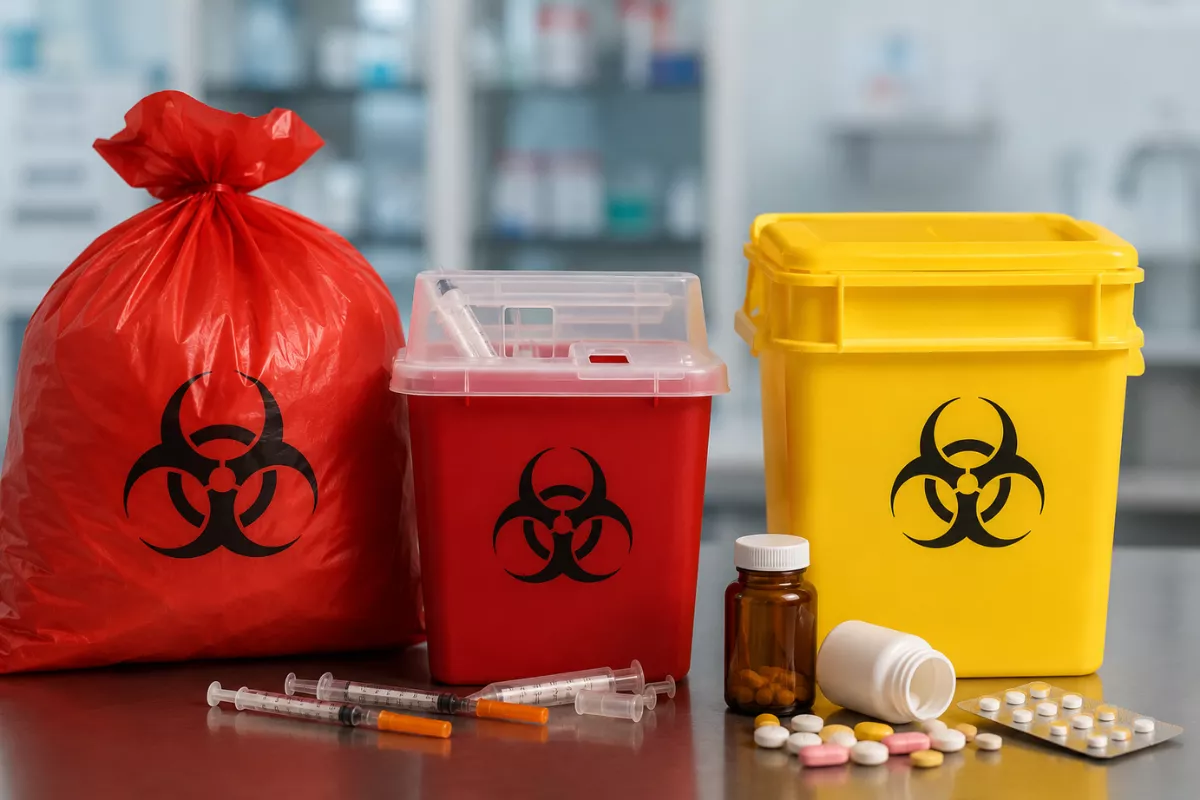
This waste differs from red bag-regulated medical waste. Red bag waste primarily focuses on infectious risks, such as blood-contaminated materials, cultures, and sharps. Pharmaceutical waste is driven by chemical properties and by the potential for toxicity, environmental harm, or diversion. Some drugs are highly toxic to ecosystems, others are acutely poisonous to humans, and many are controlled substances that can be abused if they fall into the wrong hands.
Due to these risks, pharmaceutical waste cannot be disposed of by simply pouring it down sinks, flushing it into sewer systems, or throwing it into ordinary trash. A structured program that categorizes pharmaceutical waste into four core categories enables healthcare leaders to remain compliant while prioritizing the protection of patients, staff, and the community.
Category One: RCRA Hazardous Pharmaceutical Waste
The first category is RCRA-regulated hazardous pharmaceutical waste, as defined under the Resource Conservation and Recovery Act. These are drugs that meet specific EPA definitions for ignitability, corrosivity, reactivity, or toxicity, or that appear on one of the EPA’s P or U hazardous waste lists.
Common examples include specific chemotherapy agents, certain formulations of warfarin, concentrated nicotine products, outdated solvents, and specific bulk chemicals used in the compounding process. These drugs can pose serious risks even at low concentrations, so regulators require meticulous handling from the moment they become waste until their final destruction. RCRA Black disposal containers learn more.
A compliant program for RCRA hazardous pharmaceutical waste typically includes:
Staff education ensures that nurses, pharmacists, and technicians understand which medications fall into this category based on a facility-specific formulary review.
Clearly labeled, dedicated containers that are compatible with the waste and closed when not in use.
Storage practices that comply with accumulation time limits and container requirements under federal and state rules.
Shipping documentation and manifesting that meet EPA and DOT expectations for hazardous materials.
In many facilities, the complexity begins with the formulary itself. Each drug must be evaluated against RCRA criteria, and the resulting list must be translated into user-friendly tools for use at the bedside and in the pharmacy. Secure Waste supports organizations with formulary reviews, categorization, and practical guidance, enabling the segregation of RCRA hazardous waste correctly without slowing down care.
Category Two: Non-Hazardous Pharmaceutical Waste
The second category includes non-hazardous pharmaceutical waste. These are medications that do not meet RCRA hazardous criteria but still require careful management. That group may consist of certain oral tablets, numerous routine injectables, saline-based products with additives, and common over-the-counter medications when discarded in bulk quantities.
Just because these drugs are not defined as hazardous under RCRA does not mean they can be ignored. When non-hazardous pharmaceuticals are disposed of in regular trash or washed into sewers, their active ingredients can travel through landfills, wastewater systems, and surface waters. Over time, these residues accumulate in aquatic environments, disrupting the balance of wildlife and ecosystems.
Many state and local regulators now discourage or prohibit seeping pharmaceuticals, even if they are non-hazardous. Best practice is to capture this entire stream in dedicated, non-hazardous pharmaceutical containers that are sent for high-temperature incineration or another approved treatment, rather than entering the regular waste system.
For healthcare organizations, the key is simplicity. Staff should have an easy rule to follow at the point of disposal. Suppose a medication is not RCRA hazardous, not a controlled substance, and not classified as trace chemotherapy. In that case, it typically belongs in the non-hazardous pharmaceutical bin rather than in a red bag or regular trash. Clear labeling of these containers, along with ongoing training, helps maintain consistent habits and reduces the risk of errors.
Secure Waste designs non-hazardous pharmaceutical programs that strike a balance between compliance, environmental responsibility, and cost control. By capturing this stream properly, facilities reduce the chance of negative headlines about pharmaceuticals appearing in local water supplies and demonstrate a proactive approach to sustainability.
Category Three: Controlled Substance Waste
The third category is controlled substance waste. These are medications regulated by the DEA because of their potential for abuse or addiction. They include many opioids, benzodiazepines, stimulants, and other drugs commonly used for pain management, anesthesia, and behavioral health.
The primary risk with controlled substance waste is diversion. If a partially used vial or leftover dose is not destroyed correctly, there is a real possibility that a staff member, visitor, or even another patient could take it. Diversion harms patients who do not receive full doses, puts impaired staff and the public at risk, and exposes the organization to severe regulatory and legal consequences.
A robust controlled substance waste program must address both security and compliance. That usually involves:
Policies that require witnessed wasting of controlled substances, with documentation in the medication administration record or automated dispensing system.
Secure containers that chemically deactivate the drug as soon as it is discarded, making it unusable and unrecoverable.
Restricted access and chain of custody controls for any containers accumulating controlled substance waste.
Alignment with DEA expectations for destruction and recordkeeping.
Education is essential. Staff must understand that controlled substance waste should never be poured into sinks or toilets and should not be placed in ordinary pharmaceutical waste containers. They should also be able to recognize red flags for diversion, such as discrepancies, unusual documentation patterns, or high waste rates.
Secure Waste helps organizations select and integrate appropriate controlled substance destruction solutions into their daily workflows. The goal is to make the right choice the easy choice every time a dose is wasted, while providing documentation that withstands review by the DEA and accrediting bodies.
Category Four: Chemotherapy and Cytotoxic Pharmaceutical Waste
The fourth category covers chemotherapy and other cytotoxic pharmaceutical waste. Many antineoplastic drugs are hazardous not only to cancer cells but also to healthy tissues, staff, and the environment. Some of these medications are regulated as RCRA hazardous, while others are managed as non-RCRA chemo waste under facility policy and state guidance.
Within this category, facilities often distinguish between bulk chemotherapy waste and trace chemotherapy waste. Bulk chemo waste includes items that contain significant residual amounts of chemotherapy drugs, such as partially used vials, IV bags with more than a small amount of drug remaining, and expired stock. Trace chemo waste usually refers to materials that are contaminated but contain only small residual amounts, such as empty vials, IV tubing with minimal residue, or personal protective equipment used during administration.
Both types require special handling. Staff must wear appropriate personal protective equipment when handling and disposing of chemotherapy waste, and containers must be clearly labeled to prevent cross-contamination with other waste streams. Treatment typically involves high-temperature incineration in specialized facilities that can safely neutralize cytotoxic compounds.
Secure Waste supports healthcare organizations in mapping their chemotherapy workflows, specifying container types and locations, and creating practical job aids for nurses and oncology technicians. When chemotherapy waste is managed as its own category, staff can protect themselves from occupational exposure while protecting the environment from long-term contamination.
Building a Practical Segregation System Around These Four Categories
Understanding the four categories of pharmaceutical waste is only the first step. The fundamental transformation occurs when a healthcare facility redesigns its physical spaces, container layouts, and training to align with these categories in a way that is intuitive for staff.
In practice, this often begins with a walk-through of key areas, including the pharmacy, medication rooms, procedure suites, oncology units, and operating rooms. Leaders observe where medication preparation and administration actually take place and then position labeled containers so that staff do not have to leave the patient area or improvise during busy shifts.
Color coding, plain language labels, and simple examples on container signage all help. Nurses should be able to glance at a container and immediately know whether a particular vial belongs there. Pharmacy leadership, environmental services, and nursing education should all have input, as they each view different aspects of the waste lifecycle.
Secure Waste collaborates with facilities to develop site-specific segregation plans that reflect their formularies, state regulations, and physical layouts. The result is a system that is easier for staff to follow and easier for compliance teams to defend during audits.
Training, Auditing, and Continuous Improvement
Even the best-designed container system will fail if staff are not adequately trained and the processes are not regularly reviewed and updated. Pharmaceutical waste management is not a one-time project; it is an ongoing process. It is an ongoing program that should evolve as new medications, units, and regulations emerge.
Orientation training for new employees should cover the four waste categories, how to recognize each, and how to use the containers in their department. Annual refresher training can reinforce key concepts, highlight common errors, and share findings from recent audits and inspections.
Periodic observations and waste audits provide real data. If RCRA hazardous drugs are found in non-hazardous containers, or if controlled substances are not being properly destroyed, leaders can target follow-up education and adjust workflows. Documentation of these efforts demonstrates to regulators that the facility is actively managing its program, rather than taking a passive approach.
Secure Waste provides educational materials, online training options, and audit support so that healthcare organizations are not alone in this work. With the right partner, continuous improvement becomes manageable instead of overwhelming.
Why Partnering With Secure Waste Makes Pharmaceutical Waste Management Easier
Pharmaceutical waste impacts regulation, safety, and environmental responsibility simultaneously. Trying to manage everything internally without outside expertise can consume a significant amount of time and still leave gaps.
Secure Waste focuses specifically on healthcare waste streams and understands the real-world pressures inside hospitals and clinics. By helping organizations categorize their pharmaceutical waste into RCRA hazardous, non-hazardous, controlled substances, and chemotherapy or cytotoxic waste, Secure Waste creates a framework that is both compliant and practical.
Support often includes:
Formulary reviews that assign drugs to the correct waste category.
Recommendations for container types, sizes, and locations in each department.
Clear labeling and staff education that simplify daily decisions.
Regulatory guidance for EPA, DOT, DEA, and relevant state requirements.
Treatment and disposal options that prevent pharmaceuticals from entering waterways and landfills.
Audit-ready documentation and reporting.
With this level of support, healthcare leaders can be confident that their pharmaceutical waste program is not only safe and compliant but also aligned with their broader sustainability goals.
Conclusion: Turning Complex Rules Into Simple Daily Habits
Pharmaceutical waste management does not have to be a mystery. When healthcare organizations understand the four core categories of pharmaceutical waste and design their programs accordingly, they transform a complex regulatory challenge into a set of simple, repeatable habits.
By distinguishing between RCRA hazardous drugs and non-hazardous medications, treating controlled substances as a unique diversion risk, and managing chemotherapy waste with the respect it deserves, facilities can simultaneously protect patients, staff, and the environment.
Secure Waste helps bridge the gap between regulations on paper and workflows at the bedside. If you want a pharmaceutical waste program that is easier for staff to follow and stronger from a compliance perspective, visit SecureWaste.net and explore how a tailored solution can support your facility.
Expert Medical Waste Management: With over 25 years of industry experience, Secure Waste is a trusted local leader in hazardous and biohazardous waste disposal across Maryland, Virginia, and Washington, D.C. Specializing in medical waste management, sharps needle disposal, and biohazard waste removal, the company ensures full compliance with federal, state, and local regulations while prioritizing environmental sustainability.
The company also offers additional services, including secure document shredding and sharps container sales, providing comprehensive solutions for healthcare facilities and businesses. Our cost-effective services help clients maintain regulatory compliance without unexpected costs.
With a commitment to customer satisfaction, Secure Waste offers tailored waste management plans that align with industry best practices. Their team of experts provides reliable, timely, and compliant services, making them the preferred choice for medical waste disposal. For a free waste quote or more information, visit www.securewaste.net